
The panel noted that the macro-economic fundamentals of the economy are sound but challenges remain, several of which are structural in nature.

Manufacturing sector, which constitutes over 77 per cent of the index, showed a decline of 0.4 per cent in June as compared to a growth of 7.5 per cent in the same month last year.

Retail inflation jumped to a 15-month high of 7.44 per cent in July as prices of vegetables and other food items spiked, according to official data released on Monday. The Consumer Price Index (CPI) based inflation was at 4.87 in June and 6.71 per cent in July 2022. Previously, high inflation was recorded at 7.79 per cent in April 2022.

Crisil Research expects retail inflation to rise 60 basis points to 4 per cent this fiscal from 3.4 per cent in 2018-19.

The RBI projection of 6.9 per cent GVA growth for the current fiscal comes on the back of the Economic Survey last week forecasting economic growth of 6.5 per cent.

Industrial production grows at 2.1 per cent in March.

Prices have continued to move up in Delhi's markets, wholesale and retail, on supply worries and spoilage due to record cold weather.

Rs 1,000 crore for promotion of start ups.

A careful reading of the national income accounts suggests that after a strong recovery from the pandemic, there has been a significant ebbing of dynamism over the last three quarters to more modest levels recently, note Arvind Subramanian and Josh Felman.

In terms of industries, 17 out of 23 industry groups in the manufacturing sector have shown negative growth.

Cheering the rebound in India's economy which grew 5.7 per cent in the April-June quarter, highest in the past two-and-a-half years, India Inc on Friday said it expects the GDP to pick up further on the back of conducive investment policies and execution of reforms by government.

Here are some tips to help you crack the Staff Selection Commission Combined Graduate Level Examination.

The Reserve Bank of India, which mainly factors in retail inflation to decide its monetary policy, has been tasked by the government to ensure the rate of price rise remains around 4 per cent.
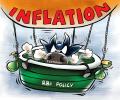
Currently, the retail inflation is well below the RBI's comfort level. The government has asked the central bank to keep inflation in the range of 4 per cent.

India economy clocked a five-year high growth rate of 7.6 per cent in 2015-16.

Economists surveyed by Reuters had forecast a 0.5 per cent growth in output
The term of the members of the Planning Commission is co-terminus with the Prime Minister and they would be submitting their resignations once the new government is formed after the ongoing general elections next month.

Retail inflation in March inched up to 8.31 per cent from 8.03 in February, mainly on account of a rise in fruit and vegetable prices.

IIP growth rises to 9-month high of 4.3 pc in August

During April-February, industrial output grew at 2.6 per cent compared with a growth of 2.8 per cent in the year-ago period.

The index had registered a growth of 2.8 per cent in January 2015.
.jpg)
The growth has not been very robust in the first two financial years of the 12th Plan.

For protein rich items such as meat and fish, eggs as well as milk and products, the inflation in May slowed compared to last month

The demonetisation seems to have impacted the GVA in the third as well as fourth quarter of 2016-17 which slipped to 6.7 per cent and 5.6 per cent respectively, from 7.3 per cent and 8.7 per cent.
India's industrial output grew a better-than-expected 6.4 per cent in August compared with a downwardly revised 4.1 per cent growth a month ago.

Retail inflation dropped marginally to 7.01 per cent in June mainly due to slight easing in prices of vegetables and pulses, though it still remained above the Reserve Bank's comfort level for the sixth month in a row. The consumer price index (CPI) based inflation stood at 7.04 per cent in the preceding month of May and 6.26 per cent in June 2021. Inflation in the food basket in June 2022 was 7.75 per cent, compared to 7.97 per cent in the previous month, as per the National Statistical Office (NSO) data released on Tuesday.

'To attribute motives to the individual election commissioner or the Election Commission as a group is very unfair.'
The government propagandists should refrain from premature celebrations and misplaced euphoria: Congress.

The IMF on Tuesday cut India's economic growth forecast by 0.5 percentage points to 9 per cent for the current fiscal year, with its chief economist Gita Gopinath saying that the slight downgrade is mainly due to the impact of the spread of the Omicron variant. "If you look at the 2021-22 fiscal year, we have a slight downgrade of -0.5 percentage points and for the next fiscal year 2022-23 we have a slight upgrade of 0.5 percentage points. So, growth for the previous fiscal year is now nine per cent and for this year now is at nine per cent. We moved it up slightly," Gopinath told reporters during a news conference in Washington. In its latest update of World Economic Outlook on Tuesday, the International Monetary Fund has cut India's economic growth forecast to 9 per cent for the current fiscal year ending March 31, joining a host of agencies which have downgraded their projections on concerns over the impact of the spread of Omicron on business activity and mobility.

Manufacturing sector, which constitutes over 75 per cent of the index, grew at 5.5 per cent in November compared to a decline in output by 4.6 per cent earlier

It said the money supply recovered to its pre-demonetisation level in mid-2017 and is now increasing steadily, similar to the previous trend.

Indian IT-BPM industry raked in revenues of $119 bn in 2014-15.

"Growth is expected to moderate gradually in China... pick up in India, and remain broadly stable in the Asean-5 region."

The previous low was recorded at 3.8 per cent in May this year.

India's industrial output unexpectedly rose 1.2 per cent in May from a year earlier, led by a pick up in manufacturing, government data showed on Tuesday.

The output, as measured by the Index of Industrial Production, had contracted by 2.5 per cent in the same month of last year.

As per the data released by the NSO, the overall food inflation rose to 14.12 per cent in December as against (-) 2.65 per cent in the same month of 2018.
The positive numbers raises hopes of recovery.

The National Council of Applied Economic Research (NCAER) on Thursday lowered the GDP projection for the current fiscal to 4.7-4.9 per cent due to exchange rate depreciation.

India's GDP is poised to accelerate to 5.5 per cent in 2014-15 on the back of improved performance in industry and services but it may take some time for the country to reach its potential growth rate, says an Asian Development Bank (ADB) report.
